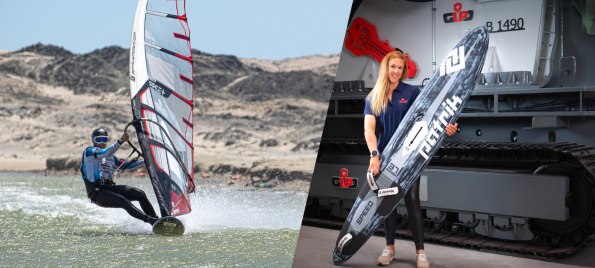

Interview: Flo Jung
Hey Flo, you’ve been active in the windsurfing scene for almost 20 years now—and you’ve made an impression not only through your athletic achievements but also with your consistently high media presence. You’ve graced countless magazine covers, produced films, and brought creative projects to life. How has your career as a pro unfolded—and how do you manage to stay relevant over so many years?
I started at age 14 on a small lake near Saarbrücken and was hooked. Unfortunately, I lived in Saarbrücken, far from the ocean. Since I didn’t have the coast right outside my door, I got creative: I built a windsurfing setup on a skateboard and jumped into the river with it. That was my start.
At 17, I went to the Maui Ocean Academy. That was my foundation. I didn’t decide to turn pro until I was 20. At first, I was on the freestyle tour, but I quickly realized that my true passion lies in the waves. Making a career out of the sport came gradually—and that ended up being freestyle again.
To get sponsors outside the surfing industry, you have to deliver something. Results or stories that inspire.
What particularly appealed to me from the start was the creative aspect of the sport, which is why I began developing creative projects early on: travel, films, photos, campaigns. I quickly realized that with the right team, at the right time, in a special place, you can create real magic. My motto has always been: less quantity, more quality. Every year, I came up with a new project or theme—something that excited me personally but also provided added value for sponsors. That was my way of staying visible while still going my own way. But beyond that, I’m still here because riding waves on a board, propelled by the wind, is still my greatest passion. ☺

What really motivated you on the tour—and what was your personal drive behind it all?
Sure, I wanted to perform well—for my sponsors, but also for myself. But I was never the type to focus everything on winning. It often didn’t feel right to squeeze that sense of freedom from windsurfing into a 12-minute heat and pull off the craziest moves on demand. But for some of my sponsors, it was important to prove myself as one of the best.
After two torn cruciate ligaments, it was clear to me: I don’t want to sacrifice everything for competition. I wanted to stay healthy and keep enjoying windsurfing.
Instead of spending every free minute training for the next contest, I often channeled my energy into projects that really mean something to me: for example, the film “Don’t Let Go,” travel stories to remote places like Alaska or Namibia, or even crossing the Atlantic as part of an environmental initiative.
My motivation wasn’t so much the podium as the feeling of creating something meaningful. Telling stories that stick with you. And moments you’ll never forget.

Do you miss the PWA Tour? And why did you stop?
My priorities have changed over the years. Especially as a father, I want to spend as much time as possible with my two children. There’s simply no room for a full contest season.
But some events still appeal to me—places like Chile, Peru, or Fiji, for example. So an occasional comeback isn’t out of the question.
Still, the motivation to do the whole tour isn’t there anymore. Today, the focus is on meaningful projects and real experiences. Of course, I miss the windsurfing bubble feeling, the shared sessions, and the friendships on the tour. I met many friends like Camille, Leon Jamaer, Graham Ezzy, and Julian Salmonn while on tour.

Where do you live—Cape Town or Europe?
My life is split pretty evenly between Cape Town and Europe. I spend about six months a year in South Africa, and the rest of the time I travel around Europe—for events, photo shoots, or my coaching camps. This mix suits me perfectly.

What do you love about Cape Town?
Cape Town is one of the most well-rounded places I know. The training conditions are world-class, the city itself is creative and vibrant, and it brings together people from all walks of life who are doing exciting things. I love the lifestyle, the climate, and the endless opportunities to be in the ocean—whether surfing, windsurfing, wing foiling, or swimming.

Tell us about your house in Cape Town and some of your projects.
About ten years ago, I discovered a special place in Scarborough, a small village south of Cape Town. Together with a friend, I built a sustainable house there—made of hemp. It’s small, but it has everything I need: minimalist design, sustainability, and a view of the spot.
In addition to windsurfing, I test products for my sponsor AK, who designs items like foils, boards, and many other products here. I’m deeply involved in my nonprofit project called Mon Coeur, which I founded after my first trip to South Africa 18 years ago. Four years ago, we opened the Inspire Hub—a learning center for youth from underserved communities. It offers workshops, TED-style talks, and sports programs. It has grown from a small idea into a truly significant project for the community.

How long have you been with Gunsails?
I’ve been associated with Gunsails since 2001. Back then, I worked in the warehouse to finance my first trip to Maui. Since then, our relationship has grown closer and closer. The company is based in Saarbrücken, and over the years, I’ve developed close friendships with the team.
Are you involved in sail design?
Yes, especially in the development of the “Seal” wave sail. I contribute my experience from the water. Of course, Renato Molotti, the designer in Tarifa, handles the technical implementation—but we work closely together to ensure the sail truly delivers what riders need.
How important is it to you that your sponsors are sustainable?
Extremely important. As water sports enthusiasts, we depend on nature every day. I believe we have a responsibility to protect it. I want to work with brands that embody these values not just in their marketing, but also in their production, materials, and mindset. Ultimately, I’m promoting these products, so I want to be able to stand behind them. Starboard and Gunsails are pioneers in this regard—they’re truly driving sustainability forward. For me, it’s not just about performance, but about partnering with brands that understand how to shape a better future.

What makes your Wave Camps special—and what can participants expect from a coaching event like this?
My camps are, of course, primarily about windsurfing and wing surfing, but they’re also about other things. Many come to improve their surfing, but they go home with so much more: a clearer mindset, greater self-confidence, new friends, and a sense of accomplishment that leaves a positive impact on them.
Together with my co-trainer Nick Spangenberg, we’ve developed a really solid program over the last ten years that not only teaches wave understanding and moves, but also mental skills like focus, flow, and managing fear. I try to pass on my experience from 20 years as a professional athlete, in a personalized way—but always within a framework that motivates, inspires, and is fun.
The groups are small, the coaching is personalized. Depending on the wind: often theory, video analysis, and mental preparation in the morning—then out on the water together in the afternoon.
Something that’s often underestimated: the community is a huge part of the experience. Many participants stay in touch for a long time, and some even start joint projects afterward—it’s a space for growth, connection, and joy, and that’s really fun.

Do you still push yourself to the limit when freesurfing?
Yes, but in a smarter way these days. ☺ My sessions usually don’t last longer than 90 minutes, but they’re very focused. That way, I minimize the risk of injury and stay fully in the flow. These days, my focus is more on perfecting timing, style, and moves—or simply on enjoying the process. Windsurfing never gets boring because the ocean is constantly changing.
What are your goals when freesurfing?
My goal is to be fully present. I set small challenges for myself that help me stay focused and push me forward—for example, linking a clean aerial with a bottom turn or executing three turns on a wave with complete control. These mini-goals help me stay in the moment—and truly enjoy the ride.
Where do you see yourself in ten years?
I see life as a journey of constant growth. I love being in the water and making the most of every free minute, whether as a pro or not. Especially in recent years, big wave surfing and wing surfing have introduced even more sports into my life that fascinate me. But the fact is that the industry is going through tough times right now, and budgets have been severely cut in recent years. We’ll see where the journey takes me.
Fortunately, in addition to windsurfing, I’ve also developed a passion for building other projects—especially in the field of social entrepreneurship. You might not get rich doing that either, but my main priority is to do something meaningful—whether through coaching, films, or creative ventures where you can make the most of your talents.

What’s the move you’re most proud of?
One move I developed myself is a variation of the Rodeo Flip called the “Ocean Jump.” It’s a kind of cheese roll in switch stance with your back to the sail—though it’s not exactly easy to land.
But honestly: The moves that excite me the most aren’t always the most technically demanding ones, but the ones that feel the best. A clean aerial or a stylish goiter still make me really happy.

What have you learned about life during your time as a professional windsurfer?
First and foremost, that nothing happens overnight. Windsurfing might look easy—but until you’ve truly mastered the wind, the waves, and your equipment, you need a hell of a lot of patience and discipline. And almost every windsurfer I know has that kind of perseverance. That translates directly to life: stick with it, even when things get tough—but that’s how you can keep learning new things over the long term. It’s an incredible character trait that many people don’t even realize they have.
As a pro, you’re not just an athlete, but also your own tour guide, logistics coordinator, and project manager. You have to organize yourself, make constant decisions, communicate with sponsors—and stay as relaxed as possible when things at the spot don’t go as planned.
The most important skill? Adaptability—both on the water and on land.
You can have the best forecast—and still, the wind doesn’t show up. I used to get upset about that. Today, I grab a coffee and use the time for something else.
And that’s perhaps the biggest lesson: Not everything goes according to plan—and that’s okay. In the end, I’m grateful for all these lessons, which help me navigate life better.

You can learn more about Flo Jung here: www.florianjung.com
April 28, 2025 © DAILY DOSE | text: John Carter | photos/graphics: Farina Deutschmann, Fish Bowl Diaries, Flo Jung, Julian Robinet, Privat, Samuel Tome | translation: DE