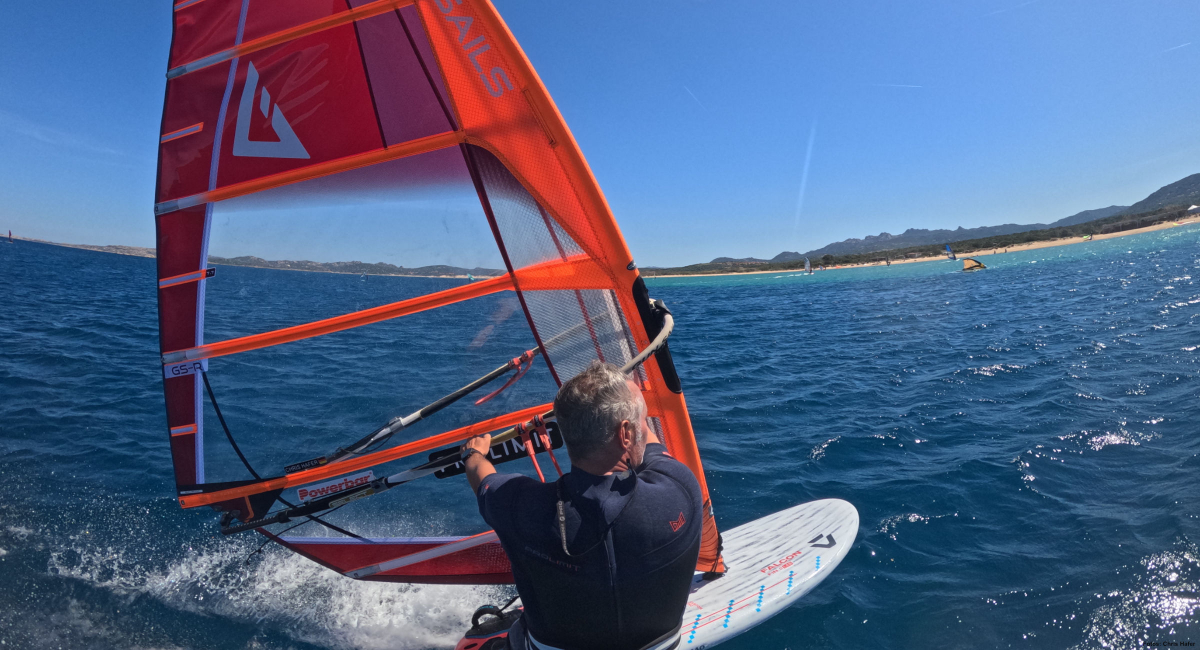
Windsurfing vacation in Sardinia
Chris Hafer visited Sardinia and brought back a report along with a spot guide.
“It’s been a hell of a long time, a hell of a long time”…probably the best-known song by Wolfgang Niedecken and his german band BAP from 1981. So it’s also been a hell of a long time since this song was written. But Wolfgang Niedecken and his band are still performing on stage, filling clubs, arenas, and stadiums. This song is still a staple of every BAP festival, and the entire audience still celebrates it and sings along at the top of their lungs from the very first verse.
It’s also been a hell of a long time since I first went to Sardinia to visit a friend who was working there for a year. He got in touch from there and reported that the windsurfing conditions were pretty good. And asked if I could bring him his parents’ cookies for Christmas. The part about the “pretty good” windsurfing conditions was only slightly understated—that much was already clear after I’d driven around the island for the first time with a buddy, back then in a station wagon. Back then, there was no internet, no wind forecasts, no spot guides. Just a map of the island with handwritten notes—it bore a certain resemblance to the map of Treasure Island. And, of course, the Christmas cookies. They even arrived on time at the recipient’s place, only to end up on the floor along with the tin due to my clumsiness…but even crumbled, they were delicious…
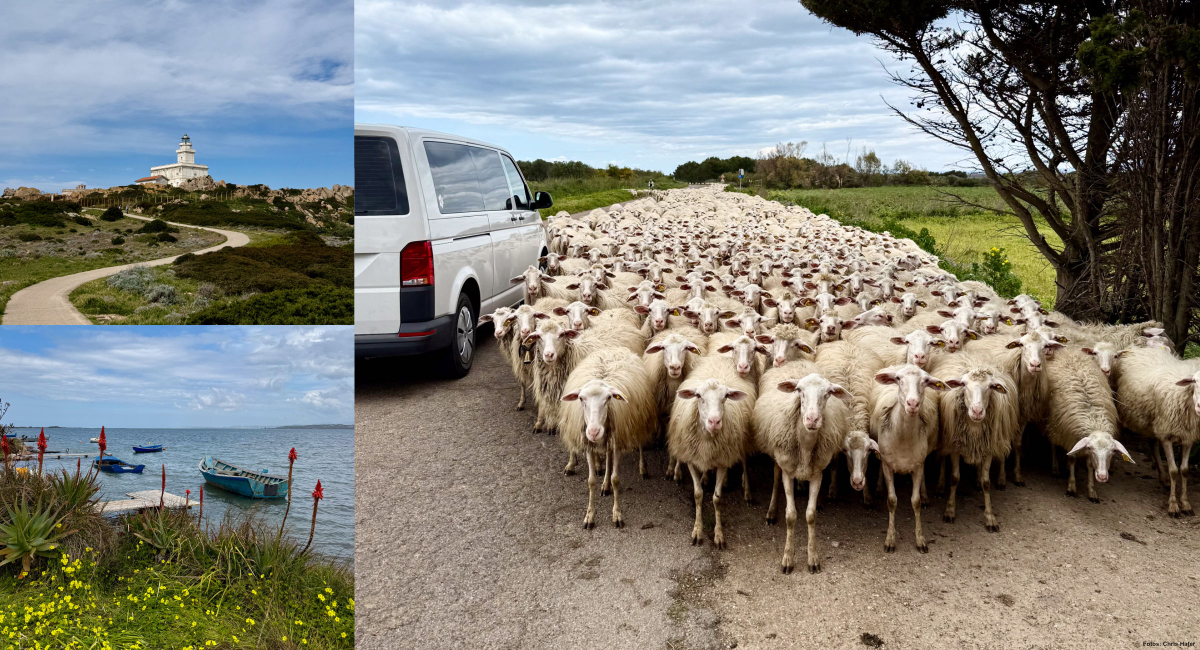
There are places that have a certain magic to them, that just feel right and good from the very first day. Places where you feel at home. Places you used to only read about or hear stories of. Places that eventually take on a life of their own, filled with memories—almost like another facet or layer.
Sardinia is one of those places for me. I’ve been lucky enough to have traveled quite a bit around the world. And to keep discovering new places that weren’t really on my radar. Places that are off the beaten path. That are rugged and unspoiled. That surprise and captivate you. And in all those years, no trip was really a bad one, even if the surfing conditions were. When you travel with the right people, even flat water isn’t a problem. Because there’s always so much to discover and experience if you let yourself.
Sardinia captivated me immediately, not only because of its incredibly beautiful nature with Caribbean-colored waters and secluded bays. But also because you can subconsciously sense how multi-layered the island is—that it has more layers of history than, to use a figurative comparison, a good lasagna, with everything interwoven.
Especially in those quiet moments somewhere on the beach, with the timeless mountains in the background, the faint scent of a wood fire wafting from somewhere, and the soundtrack of a few bleating sheep, a journey through time begins—at least in my imagination. I wonder what it was like when, in 2000 B.C., the first inhabitants of Sardinia left their lasting mark on the island. They erected their nuraghi, stone towers and fortresses. They built well temples, whose precision would push any Sardinian craftsman to his limits, to worship the water essential for life. They covered the entire island with a dense network of nuraghi and left behind strange bronze figures and giant stone statues for which science still has no plausible explanation and about whose culture virtually nothing is known.
According to estimates, Sardinia was more densely populated back then than it is today. At least if you leave out the tourists during the season. Because there probably weren’t as many people in the entire Mediterranean region 1,000 years before Christ as there are now flocking to Sardinia in the summer—at least that’s how it feels.
After the mysterious Nuragic culture came the Phoenicians, the Romans, the Spanish, the pirates, the German occupiers during World War II…and they all left their mark, not just in the form of buildings. And you can sense all of this if you open yourself up to it and pay attention.
The fact that history repeats itself and new groups keep arriving across the sea is evident in the tourists already mentioned. According to a Sardinian proverb, nothing good ever comes across the sea—another reason why most cities were built inland, away from the beaches, and why the entire coastline is lined with a network of defensive and signal towers.
Just as tourism in general can often pose a problem for the region in question, it has also become apparent in Sardinia in recent years that an increasing number of tourists—particularly those traveling in RVs—are causing issues, as more and more beaches are barely visible even in the early season due to the sheer number of RVs. Especially when official campgrounds are often still closed, everyone really should be mindful of their actions and behavior, leaving no traces or trash behind.
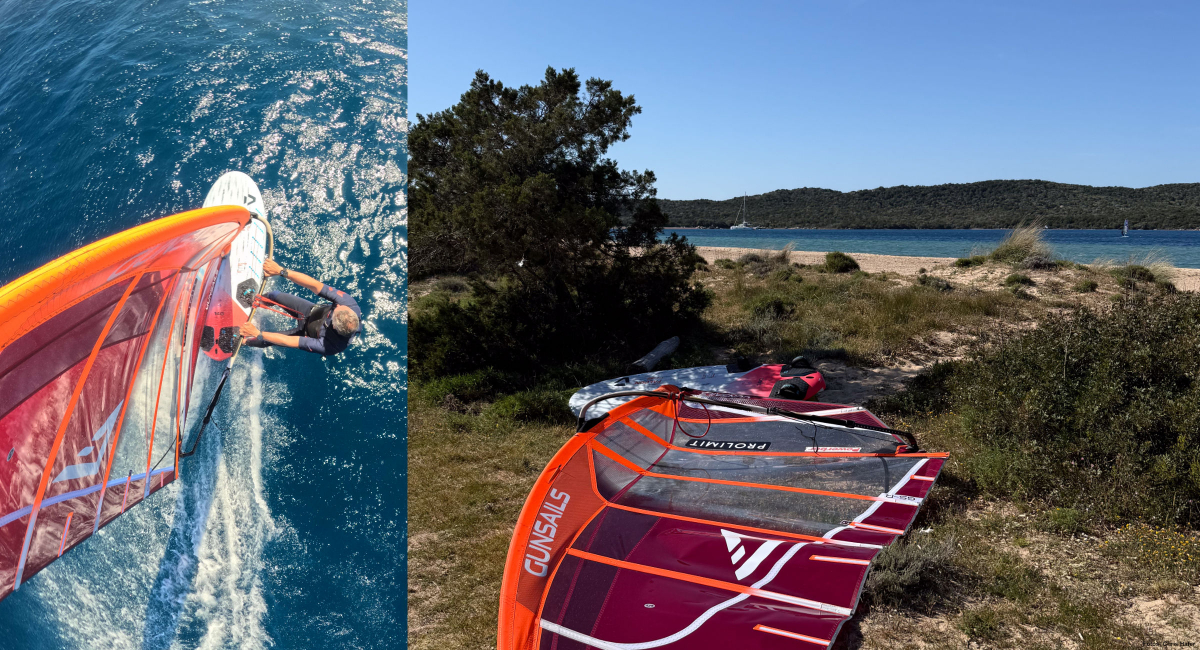
The Sardinian waste disposal system doesn’t exactly make this any easier. There is no universal waste collection service with monthly fees; instead, Sardinians must dispose of their own trash in designated containers at their own expense. Whether this actually always happens is highly doubtful after a bike ride through the mountains, when you have the time to glance into the roadside ditches while climbing at 7 km/h despite being short of breath. The fact that public trash cans are now virtually nonexistent on most promenades or in towns doesn’t exactly make things cleaner or easier either. Whereas insider tips among surfers about the nearest drinking water source and fountains used to be the hot topic, the proper way to dispose of one’s trash is now considered just as important.
After all, the long-term damage caused by illegal trash disposal in nature is evident on a walk along the beach, no matter how sheltered the bay may be. Plastic has now far surpassed mussels and natural flotsam in terms of volume. And when you take a closer look at how the sand is now riddled with microplastics, it’s actually no longer surprising that species keep going extinct. But our plastic waste will likely even outlast the stone remains of the Nuragic culture.
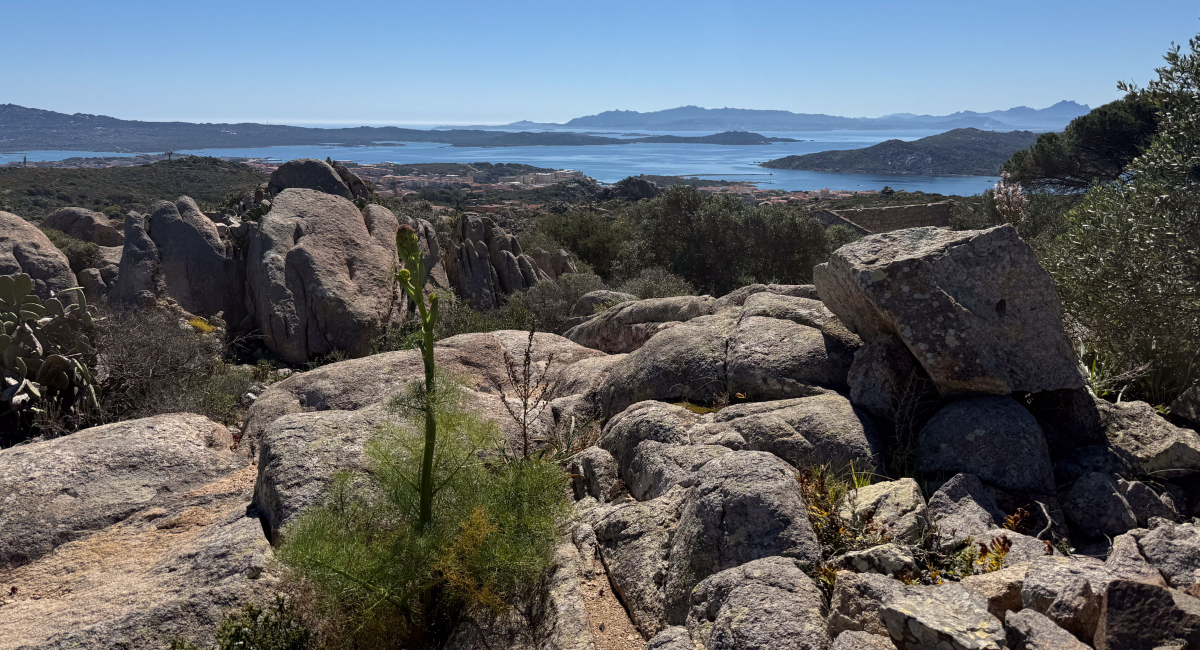
Still, I always enjoy going back there—though perhaps with a bit more awareness than I used to. It’s wonderful to see that old acquaintances have become friends who welcome me so warmly that it feels like coming home. Daniele, Gigi, Matteo… they all welcome me with open arms time and again and are proud of their island. For me, these are exactly the moments I’m so grateful for—that windsurfing and traveling allow me to meet like-minded people, to share something in common, no matter how different our backgrounds and daily lives may be.
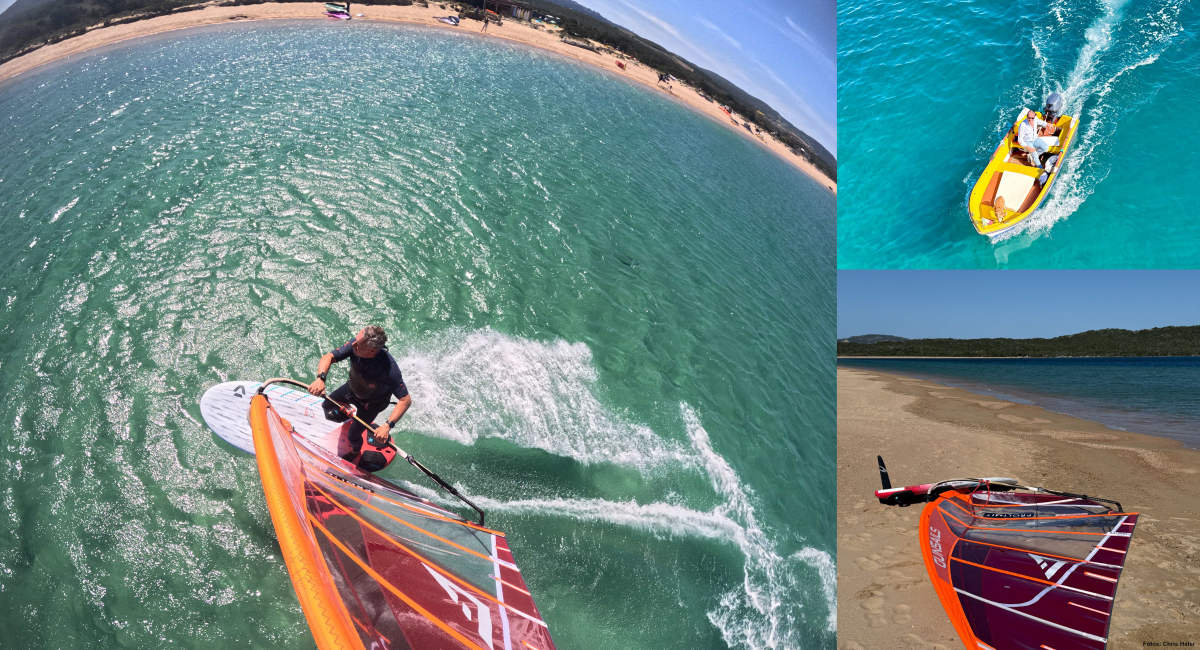
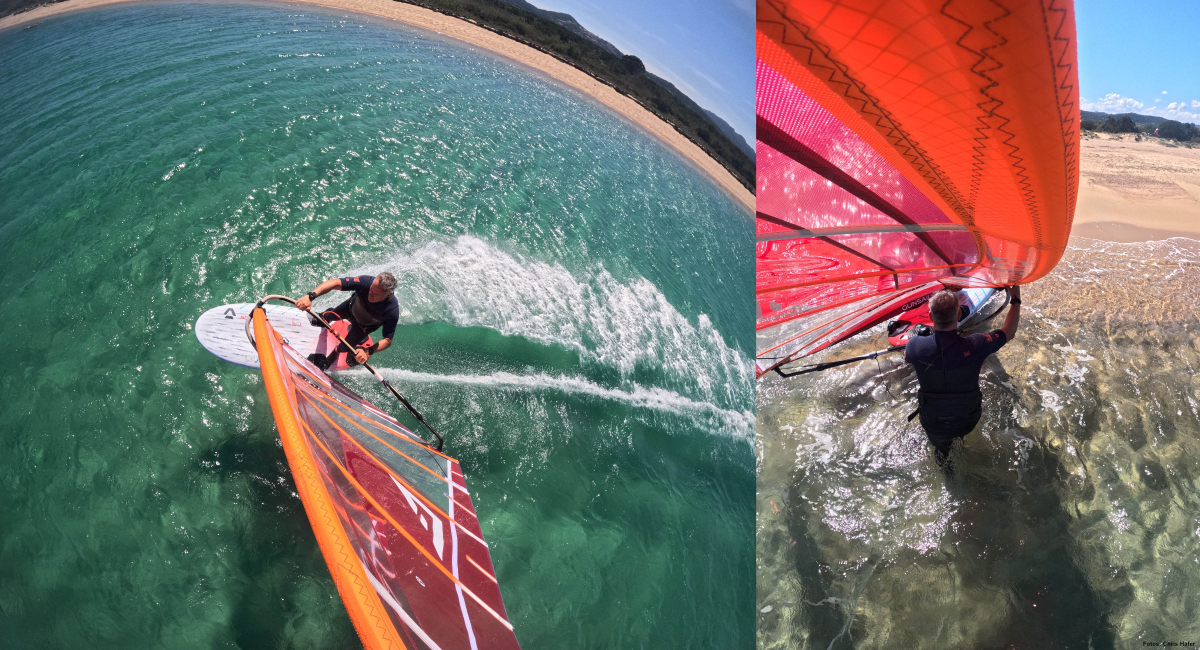
I still have the old map of Sardinia with the marked locations and surf spots, but these days I tend to rely more on weather forecasts or tips from the locals and let myself drift across the island, always on the lookout for the best conditions. That way, every trip is different, and I keep discovering new spots on the island, experiencing new moments and surprises. And this spring, the wind gods were kind to me—I was out on the water 11 out of 14 days. From perfect slalom conditions with glassy water to amazing waves, plus plenty of sunshine… Sardinia straight out of a picture book, simply a joy to experience.
And just like Wolfgang Niedecken with his music, many of us still do what truly moves us, and it still brings a smile to our faces. Traveling and windsurfing, and always returning to places that hold special meaning for us.
PS: BAP is celebrating its 50th stage anniversary this year… hopefully I’ll still have a few years left…

Getting There:
There are now several affordable flight options from Germany to Sardinia, including flights to Olbia, Alghero, and Cagliari. For more information, check Air Berlin, Ryanair, and Tuifly.com. However, you will need to rent a car once you arrive; car rentals are relatively expensive in Sardinia, so be sure to ensure the vehicle has adequate insurance coverage.
The classic way to travel is by car via ferry, e.g., from Livorno or Genoa, such as with www.mobylines.de.
There are no highway tolls in Sardinia itself, but the island is larger than you might think, not least because of the Italian knack for building 10 km of road for
5 km as the crow flies. For the 290 km from Olbia to Sant’Antioco, you can expect a driving time of about 4 hours. However, Sardinia also has plenty of sights to offer along the way…
Accommodation:
If you want to be mobile, you’ll generally be tolerated in most places with your campervan if you behave appropriately during the early season. Alternatively, you can rent an apartment as a base camp. You’ll find many offers at www.fewo-direkt.de or through other providers; especially in the early season, you can often still negotiate! The website www.sardinien.com is also highly recommended, with plenty of information about the island! Giggi Maddedu also arranges accommodations on Sant’Antioco (@sabarra.it). There are also campgrounds on Sant’Antioco (http://www.campingtonnara.de / www.campinglesaline.com).
Food and shopping are cheaper on Sant’Antioco than on the mainland.
Spot Guide:
Sardinia is surfable year-round, but the best time to visit is in the spring. Wetsuit
recommendation is a 4/3 or short-sleeve; shoes are advisable at many spots due to sea urchins or sharp reefs. Surf shops are few and far between, and equipment rentals are limited. From March to November, wind statistics show a 70% chance of onshore winds; in winter, low-pressure systems bring wind.
South Coast:
Sa Barra: A large lagoon between the Sardinian mainland and the island of Sant’Antioco. Downwind, the breakwater between Sant’Antioco and the mainland prevents drifting, and numerous steep sections also ensure safety. Watch out a bit for fishing lines; otherwise, there are no obstacles and plenty of space for all skill levels to practice their next maneuver under ideal conditions. Paid access to Giggi Maddedu’s surf station is not possible for oversized RVs due to the narrow paths. Everyone else will find not only the option to rent gear but also restrooms, a bar, and a very relaxed atmosphere (www.sabarra.it). The best wind direction is northwest; due to local thermals and the location, you’ll get significantly more wind than forecast. Southeast winds—i.e., the Scirocco—are also perfect for sideshore surfing and, statistically, provide 250 surfing days a year.
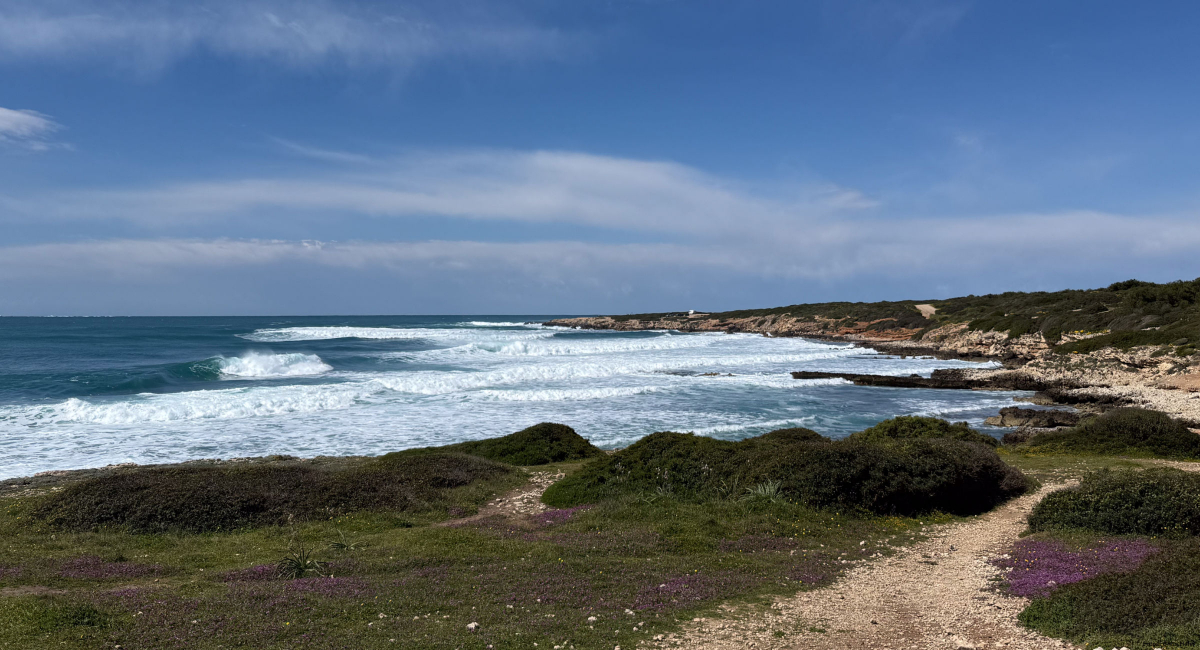
Calasetta. To the west of Calasetta, take a narrow path over a hilltop. From there, you have a view of the wave spot directly in front of you. The wave breaks from the right over a flat and partly sharp rocky reef. The waves should be at least 1–1.5 m high to ride them. Relatively safe, as a fall will carry you downwind into deeper water. However, since entry and exit are over rocks, Calasetta isn’t necessarily a beginner’s spot. The best wind direction is northwest. There should have been strong winds from this direction for a few days beforehand so the wave can build up. Limited parking, no restroom facilities.
Spiaggia Grande: Beginner spot southwest of the wave spot. Large sandy bay with very few waves. Gigi’s second surf school is also located here. Just like in Calasetta, the wind is always slightly weaker than in Sa Barra. Except for southerly winds, which are offshore here, all wind directions work.
Punta Trettu: Upwind of the lagoon and on the mainland across from Sa Barra. Here, kiters enter the water at the kite station, but windsurfing is also possible. However, the water is relatively shallow, so you should watch your fin and also respect that this spot is actually reserved for kiters. As in Sa Barra, the best wind direction is northwest; an easterly wind is offshore and very gusty due to the mountains in the hinterland. Only the industrial backdrop on the windward side spoils the view.
Chia:One of the best wave spots in Italy. It’s no coincidence that the Italian Wave Championship is regularly held here. With the Scirocco, the wind comes from the left, but even with a wind from the right, there can be very good wave conditions. A long sandy beach with a shore break and partial wind shelter provided by the dunes; a very beautiful atmosphere and stunning water colors. Best wind direction is SW-W, parking available, no restroom facilities.
Porto Pino: Located in the southwest of the island, it can offer waves with a side-offshore wind during Mistral conditions when the rest of the area is otherwise flat. A beautiful, secluded bay with a wide sandy beach; getting there is a bit tricky.
Cagliari, Poetto: The city beach, with 7 km of fine sand, ample infrastructure, and the Sardinian capital as a backdrop. With the Mistral, there’s usually an offshore wind, creating perfect slalom conditions. Rideable in almost any wind direction; we recommend the Mauro Cove surf club in the eastern part of the bay as a base. There is excellent infrastructure there, with storage for gear available, and mostly sideshore conditions. Caution: Shallow reef right in front of the entry point!
Geremeas / Villasimius: East of Cagliari, almost every bay offers opportunities for surfing; mostly with moderate swell for slalom riders when the Mistral blows, which then shifts to side- to side-onshore. In summer, there are often thermals from the west to southwest.
Porto Guincho: Dreamlike water colors and a lagoon form the perfect backdrop for slalom and speed conditions with offshore westerly winds at the very eastern tip of the island.
Costa Rei: The east coast offers expansive sandy beaches with mostly very relaxed conditions, perfect for gaining your first wave-riding experience or simply enjoying the beautiful Mediterranean scenery while freeriding.
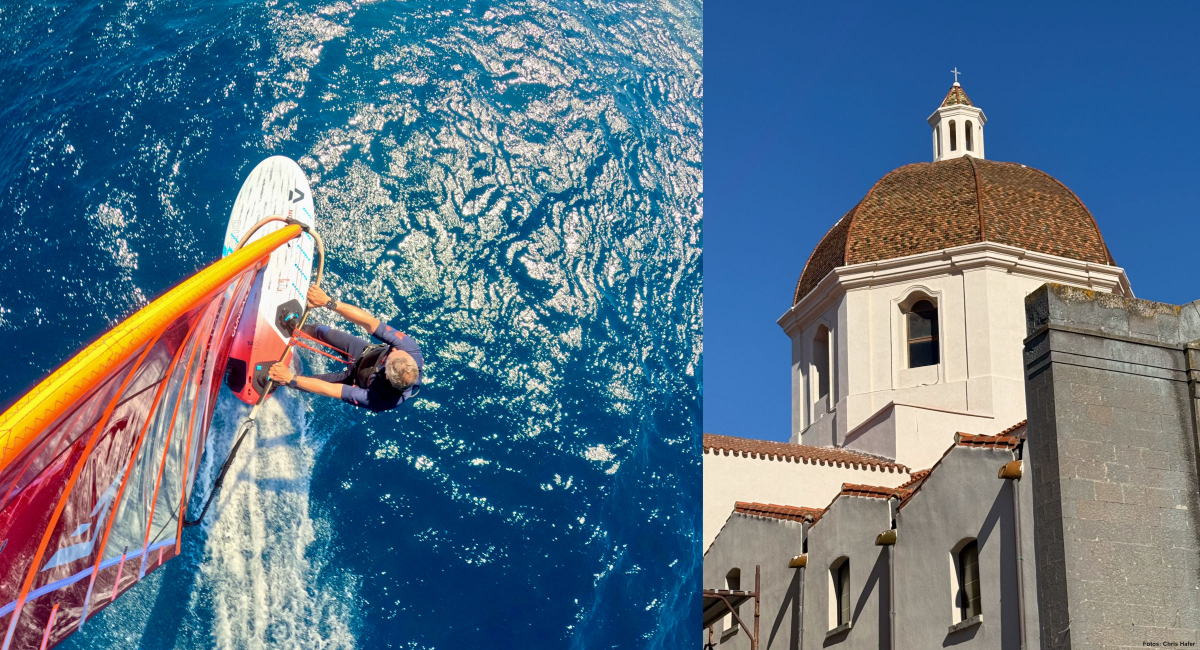
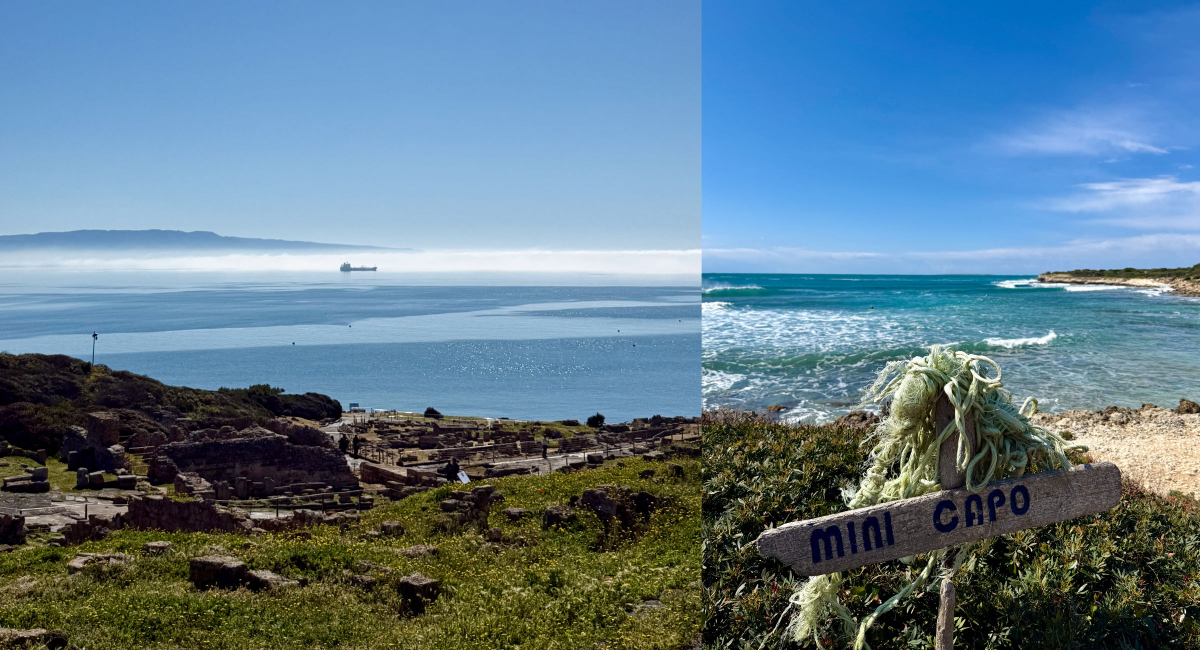
Capo Mannu: A surf spot on the western side of the island; after a prolonged period of mistral winds, it can offer fantastic conditions with wind coming from the right (NW). However: Steep rocky coastline, wind shelter near the shore, a very tricky entry point, and high waves make this spot suitable for experts only! The Mini Capo spot used to be an insider’s tip for surfers, so please respect the many locals! Access to the headland is only via a bumpy dirt road; no restroom facilities.
Putzu Idu: A bay with stunning water colors and a long sandy beach next to Capo Mannu; a slalom and wave spot with small waves when conditions get big at Capo Mannu. Works in almost any wind direction, but be careful due to many fishing lines in the water! Parking and restrooms available at the beach; there has also been a surf school, shops, and bars there for some time.
Funtana Meiga: located near the Punic/Roman archaeological site of Tharros at the southern tip. Also works well in strong Mistral winds (NW). The waves break over a shallow rocky reef; the entry point is also somewhat narrow and tricky. However, the waves—with no wind shadow—are excellent for jumping. The final stretch of the drive is on dirt roads, so it’s only recommended with caution in the rain; no restroom facilities.
Capo Pecora & Surroundings: Anyone who finds their way here is guaranteed to find empty beaches! Add to that a wild backdrop of steep rocky coasts, wide sandy beaches, and abandoned mining ruins. Along this coast and the Costa Verde, there are plenty of beaches that can offer pleasant surprises and waves depending on the wind direction. We’ve checked out some of the spots and highly recommend them for explorers!
At this point, we’d like to reiterate our request: Leave the beaches as you’d like to find them, and make sure your behavior ensures that surfers and windsurfers remain welcome guests at these spots for a long time to come—mille grazie!!
May 25, 2026 © DAILY DOSE | text: Chris Hafer | photos/graphics: Chris Hafer | translation: DE