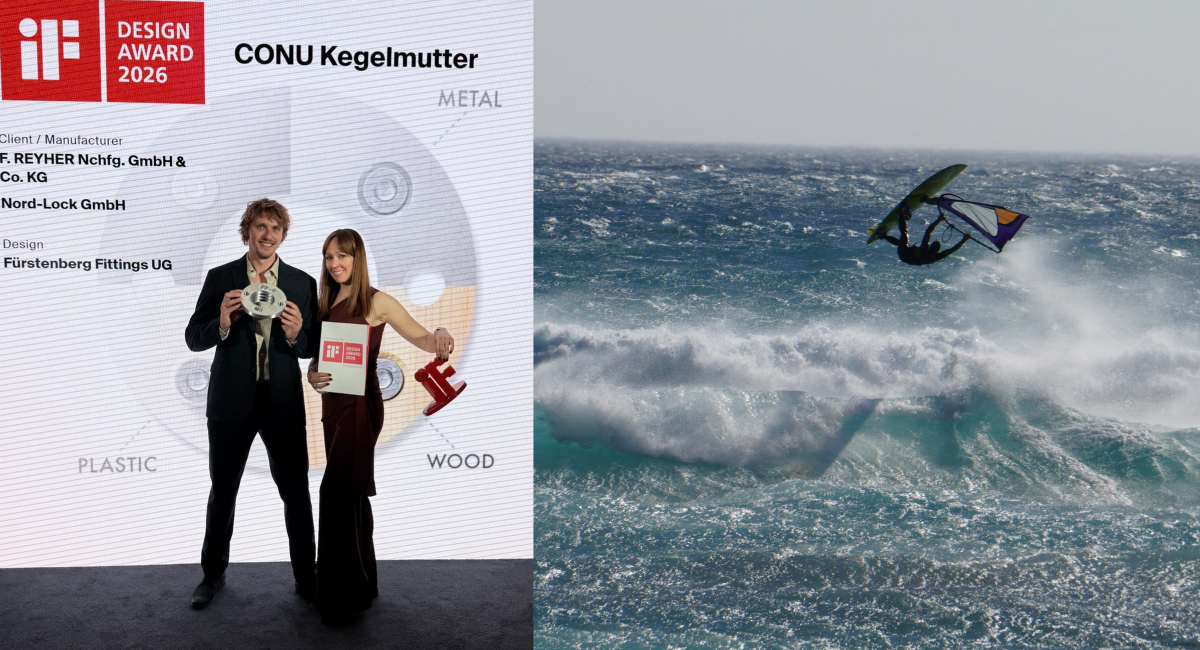
Interview: Malte Fürstenberg
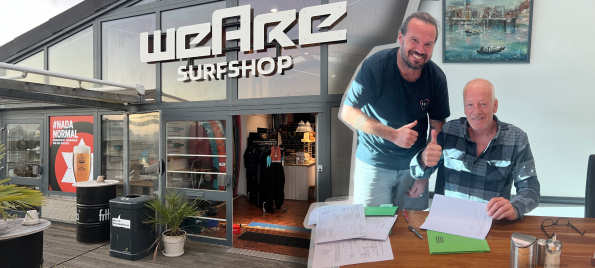
Malte Fürstenberg got his start in windsurfing. He works as a developer at Airbus. As an inventor, he also ventured into the lion’s den.
You first appeared on our site as a provider of surfboard repairs. Then things really took off with foiling. Your own inflatable boards, an e-foil project, tandem foiling, modular foil adapters, then iSUP technology adapted for tree protection, anti-slip footstrap pads, the CONU cone nut, and then suddenly you were on “The Lion’s Den” with VLIPPY door and window stoppers. Where does all this inventive spirit come from, and how did it all develop?
“To be honest, it probably started when I was a kid. I rarely just accepted things as they were, but always thought about whether they could be solved better, more simply, or more intelligently. That’s stayed with me to this day.
Water sports served as a kind of playground for that. I used to repair surfboards, later I modified my own boards, built prototypes, and was constantly trying out new things. Eventually, my first own products came along. Many of them arose from problems I experienced myself on the water.
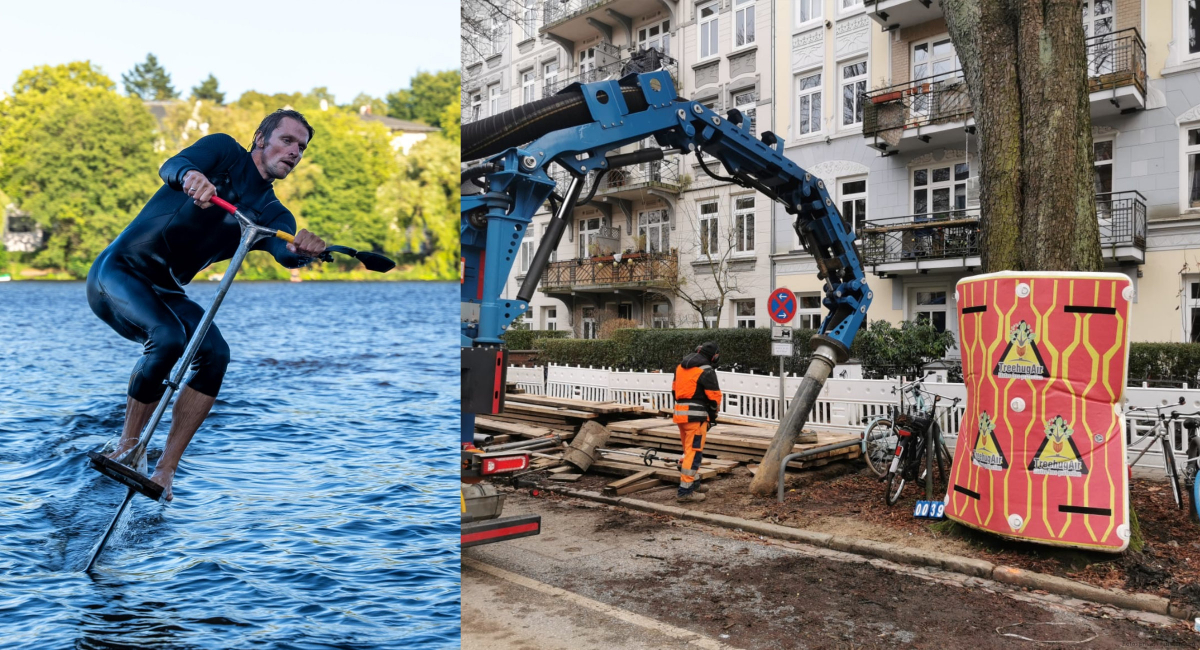
What I still find fascinating is that good ideas often work across industries. The technology behind inflatable SUP boards, for example, led to the development of TreeHugAir®, an inflatable tree protector for construction sites. Technical challenges later gave rise to CONU®, a self-locking cone nut for mechanical engineering. And VLIPPY®, in turn, emerged from a very everyday problem with doors and windows.
Many people imagine inventors as people who suddenly have a flash of inspiration. In reality, a large part of the work consists of observing, testing, failing, and persevering. Some ideas fade away, while others develop into patents or products. To date, this has resulted in over 20 patents, trademarks, and intellectual property rights.«
Do you have your roots in windsurfing? And what did your professional career look like alongside that, or how did everything come together?
“Yes, definitely. My roots are clearly in windsurfing. Even as a teenager, I was fascinated not only by the athletic aspects but also by the technology behind it. Why does one board perform better than another? Why does a fin work? How do small changes in geometry alter handling?
Later, I studied aircraft engineering and have been working in the innovation sector at Airbus for many years now. Looking back, it’s actually the perfect combination. In my studies and career, I deal with aerodynamics, lightweight construction, materials, and design. You encounter exactly the same topics again in windsurfing and foiling.
Especially when foiling, you often realize just how similar airplanes and foils actually are. Basically, you’re flying through the water on a wing. Maybe that’s exactly why this sport has fascinated me from the very beginning.
Today, the lines between hobby, career, and product development often blur completely. Many ideas come to me on the water, and many technical solutions from my professional life, in turn, help with the development of new products.”
I’ve seen you do front flips and backloops while wing foiling, and backloops while wind foiling too. Do you approach other sports in a similar way?
“Yes, absolutely. I’m actually excited by anything where you can constantly improve. That’s why I love windsurfing, wing foiling, wind foiling, SUP foiling, and surfing.
For me, it’s not necessarily about higher, faster, or more extreme. I’m more drawn to the learning process—learning new tricks, mastering new conditions, or discovering new sports.
Maybe that’s why there are parallels to inventing. In both cases, progress rarely happens right away. You try something out, fail, tweak the details, and eventually it works.”
Work and surfing—do you manage to balance the two well?
“Surprisingly, yes. Many people think that sports and work are opposites. For me, they’re more like a complement.
Being on the water clears my head. Many ideas actually don’t come at my desk, but during a session on the water or later while reflecting on it.
Conversely, the structured approach from my job also helps me with sports projects and product development.
My family, of course, also plays an important role in this. Without their understanding and support, much of this wouldn’t be possible on this scale.”
Where do you most enjoy surfing and foiling?
“Denmark, and Klitmøller in particular, are definitely among my favorite spots. I’ve spent countless hours on the water there.
But what I find particularly exciting is that foiling has completely changed the game.
In the past, you often had to rely on perfect waves or strong winds. Today, the Elbe right outside your front door, a quarry pond, or a small lake somewhere in northern Germany can suddenly become excellent surf spots.
In my view, that has revolutionized the sport. Today, many people can get out on the water right outside their front door and have great sessions without having to drive hours to the ocean.”
What’s your favorite surfing or foiling discipline right now?
“That changes all the time. Right now, I’m actually having a lot of fun with the pump foil scooter. It might seem a bit crazy at first glance, but in my view, it’s one of the most exciting developments of recent years.
The big advantage is that you can teach other people how to foil incredibly quickly with it. Many people manage their first longer rides much faster than through traditional entry-level methods.
In general, what excites me about foiling is the dynamism of the entire scene. It feels like new disciplines, new equipment, and new ideas emerge every year. It’s precisely this pace of innovation that makes it so appealing.”
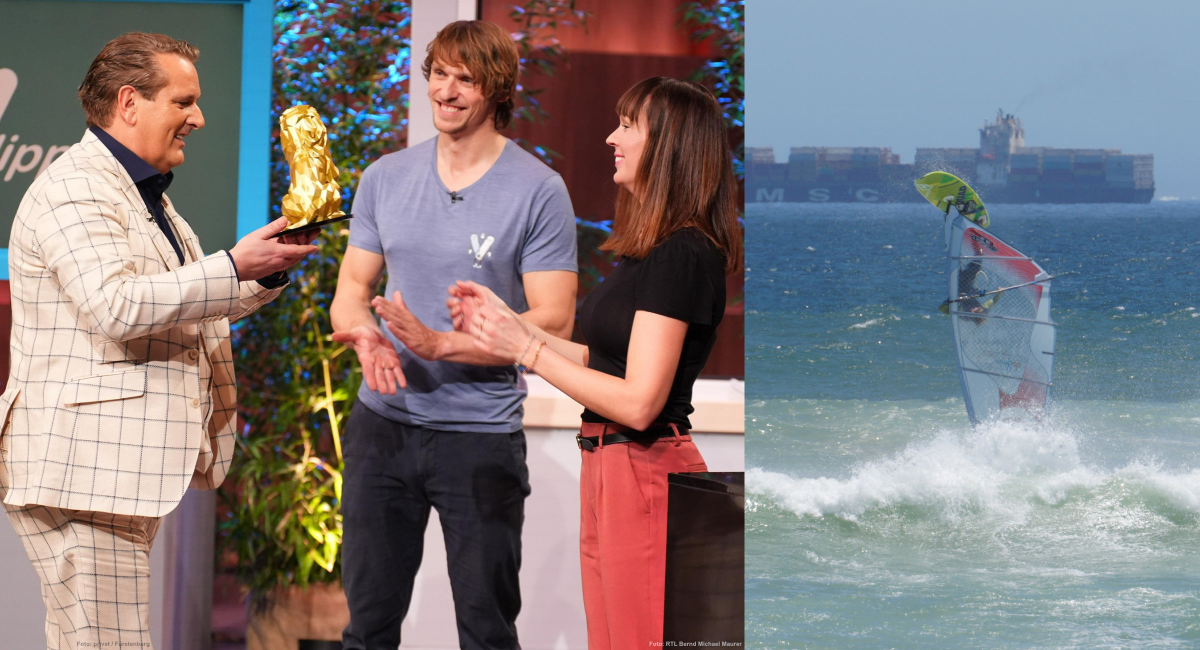
Back to the TV appearance: How did it go on *Die Höhle der Löwen*? Things got a bit chaotic. Were your expectations met? Was that a boost for sales, or is the more “behind-the-scenes” work with CONU the bigger success?
“*Die Höhle der Löwen* was definitely an experience we won’t forget anytime soon. From the outside, the show often seems very orderly. In reality, it’s much more chaotic. You get interrupted, have to react on the spot, and often can’t even finish your actual pitch.
For VLIPPY®, the show was of course a huge boost. The product is easy to understand, and practically everyone recognizes its benefits within seconds.
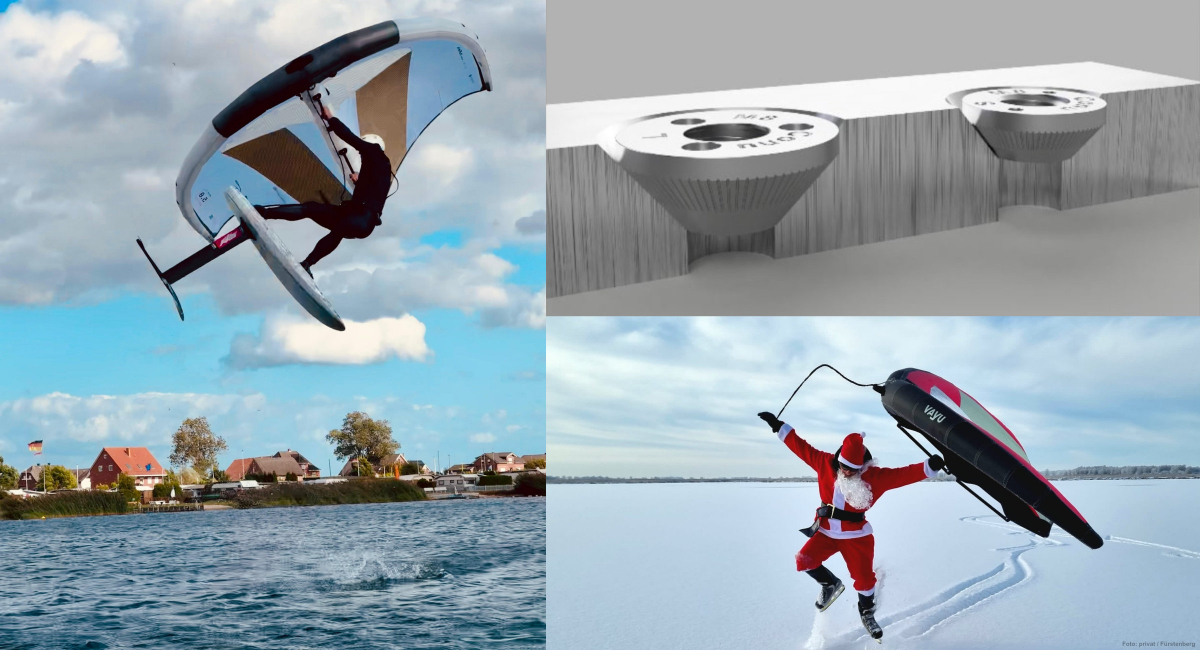
With CONU®, the situation is completely different. At first glance, the cone nut seems unremarkable. Many people initially see it as just another nut.
Interestingly, we’ve found that even professors, doctors, and experienced engineers sometimes looked at a flyer and reacted rather cautiously. However, as soon as they assembled and tried out CONU themselves, their perspective often changed instantly. Suddenly, comments like, “Now I finally understand what’s so clever about it,” started coming up.
This showed us that CONU requires a strong technical sales approach. You have to experience the product. A drawing or a flyer is often not enough.
That’s why, in the long term, we hope CONU will achieve similar success to VLIPPY®. The path to that success will likely be different, though. Less mass market, but more technical consulting, demonstrations, and personal persuasion. That’s precisely why we still see enormous potential there.”
Are you currently working on new projects or ideas, or are you focusing your efforts on existing ones?
“Actually, both. Once you start inventing, you probably never stop. Ideas come up all the time. Some are discarded within minutes, while others keep us busy for years.
Right now, though, our focus is clearly on our existing products. VLIPPY®, CONU®, and TreeHugAir® have enormous potential and deserve our full attention.
Still, new ideas pop up almost every day. My family sometimes rolls their eyes by now when I come around the corner with yet another new sketch.
Luckily, not all ideas are good. Otherwise, we’d probably have even more projects running simultaneously.”
After all these years, what still motivates you to develop new products?
“For me, the best moment is when an idea becomes something real. A sketch on a piece of paper is just an idea at first. When it later becomes a product that people use and that actually helps them, that’s an incredibly good feeling.
It hardly matters to me whether it’s a technical product for industry, tree protection for construction sites, or a door and window holder for everyday use.
I’m inspired by the idea of solving problems. That’s probably the real driving force behind it all.”
June 7, 2026 © DAILY DOSE | text: Jürgen Schall | photos/graphics: Malte Fürstenberg, Privat, RTL / Bernd Michael Maurer | translation: DE